
A Generative Analog Synth Built for Exploration
The Moog Labyrinth is a semi-modular, parallel generative analog synthesizer designed to explore evolving patterns, organic modulation, and experimental sound design. Rather than focusing on traditional keyboard-based performance, Labyrinth is built around dual generative sequencers, two analog oscillators, and a parallel signal path that encourages non-linear musical results.
Positioned between classic Moog subtractive synthesis and modern generative workflows, Labyrinth targets musicians interested in modular thinking, ambient textures, rhythmic experimentation, and self-evolving patches, while remaining accessible to users who are not deeply invested in Eurorack systems.
Our Rating: ★ 9.0 / 10
Labyrinth earns its score for its innovative generative design, expressive analog sound, and modular-friendly architecture. Minor deductions reflect its niche focus and lack of traditional performance features, but as a creative instrument, it delivers exceptional depth and inspiration.
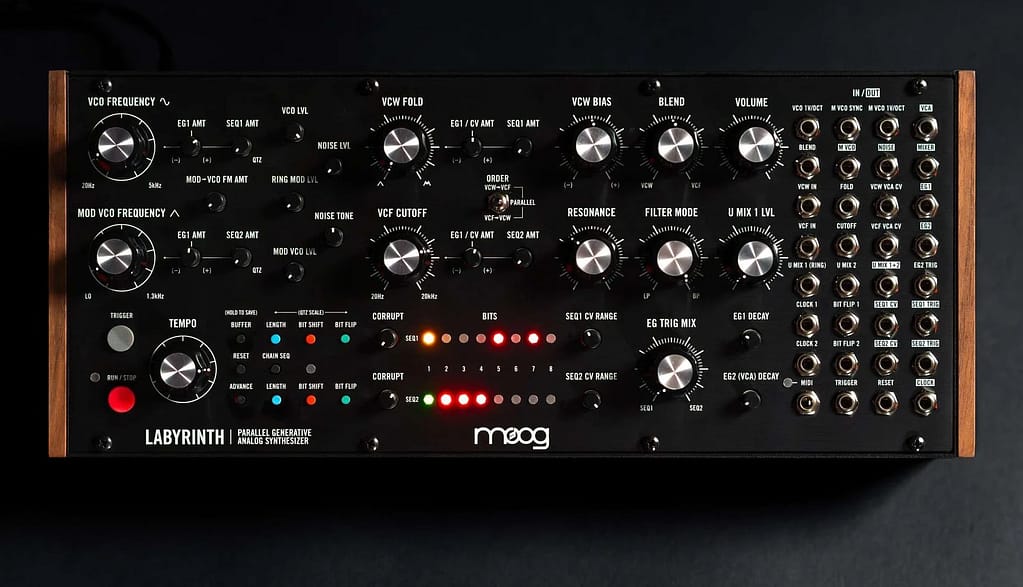
Design and Build Quality
Labyrinth follows Moog’s modern semi-modular design language, featuring a compact desktop form factor, a robust metal chassis, and a clear, performance-oriented panel layout. Controls are spacious and logically grouped, encouraging hands-on interaction rather than menu-driven operation.
The instrument is designed to sit comfortably at the center of a tabletop setup and integrates naturally with Eurorack or other semi-modular gear via its patch bay. As expected from Moog, the build quality feels solid, with smooth knobs and durable patch points designed for frequent re-patching.
Dual Oscillators and Parallel Architecture
At its core, Labyrinth features two analog oscillators, each capable of operating independently within a parallel signal architecture. Instead of a single linear signal flow, audio and modulation paths can diverge and recombine, creating complex interactions between oscillators, filters, and wave-shaping stages.
This parallel approach allows sounds to remain rich and dynamic, even with minimal modulation. Subtle differences between the two paths can result in evolving stereo-like movement and textural depth, making Labyrinth particularly effective for drones, pulses, and generative soundscapes.
Wavefolder and Filter
A key element of Labyrinth’s sound design potential is its voltage-controlled wavefolder, which adds harmonic complexity and aggressive edge to otherwise simple waveforms. This makes the synth capable of moving far beyond classic Moog tones into more experimental territory.
Complementing the wavefolder is a voltage-controlled filter, delivering the expected Moog musicality while interacting dynamically with the parallel signal paths. Together, these stages allow Labyrinth to shift seamlessly between warm, rounded tones and sharp, animated textures.
Dual Generative Sequencers
Rather than a traditional step sequencer, Labyrinth is built around two generative sequencers designed to interact with each other. These sequencers can operate independently or influence one another, producing patterns that evolve over time rather than repeating rigidly.
This design encourages exploration over precision. Rhythms, pitches, and modulation values can drift, mutate, and reconfigure themselves, resulting in constantly changing musical ideas. For users interested in ambient music, experimental electronica, or modular-inspired composition, this generative approach is central to Labyrinth’s identity.

Patch Bay and Modular Integration
The patch bay is fundamental to Labyrinth’s flexibility. It allows users to:
- Override internal routings
- Introduce external modulation sources
- Sync with other modular or semi-modular systems
- Expand generative behavior beyond the default architecture
Even without patch cables, Labyrinth offers a rich internal signal flow. With patching, it becomes a highly open-ended instrument capable of deep experimentation and integration into larger modular ecosystems.
Workflow and Creative Focus
Labyrinth is not designed for recall-based workflows or precise arrangement building. There are no presets, no display, and no traditional performance keyboard. Instead, it prioritizes immediacy, discovery, and hands-on experimentation.
Small adjustments to modulation depth, sequencing parameters, or patch routing can dramatically change outcomes, making Labyrinth an instrument that rewards time, curiosity, and active listening rather than predictable repetition.
Advantages
- Fully analog signal path with rich Moog character
- Parallel architecture encourages complex, evolving sounds
- Dual generative sequencers create non-repeating patterns
- Voltage-controlled wavefolder expands tonal range beyond classic Moog sounds
- High-quality patch bay for modular integration
- No menus or screens; entirely hands-on workflow
- Excellent build quality and thoughtful panel layout
Limitations
- No preset storage or recall
- Not designed for traditional melodic or keyboard-based playing
- Generative behavior may feel unpredictable for structured compositions
- Requires time and experimentation to fully understand
- Desktop-only format (no keys or pads)
Verdict
The Moog Labyrinth is a bold and inspiring instrument that embraces uncertainty, movement, and exploration. It is not a conventional synthesizer, and it does not try to be. Instead, it excels as a generative analog system that invites musicians to step away from fixed patterns and engage with sound as a living process.
For artists interested in ambient music, modular workflows, and evolving analog textures, Labyrinth is a uniquely rewarding instrument. While its lack of presets and structured sequencing may not suit every workflow, those willing to embrace its philosophy will find it to be one of Moog’s most creatively distinctive releases.