
Modern Digital Synth That Reimagines Analog at an Extreme Level
The Korg multi/poly is a powerful analog modeling synthesizer inspired by the legendary Korg Mono/Poly, but reimagined as a fully polyphonic, deeply modular digital instrument. Rather than attempting to replicate analog behavior superficially, the multi/poly uses Korg’s next-generation analog modeling technology to simulate the nuances, imperfections, and organic behavior of vintage hardware—while dramatically expanding flexibility and sonic range.
Designed as a polyphonic modular-style playground, the multi/poly combines massive oscillator stacks, advanced filter modeling, per-voice variation, extensive modulation, motion sequencing, and expressive performance controls into a compact, hands-on instrument aimed at sound designers and adventurous synth players.
Our Rating: ★ 9.3 / 10
The multi/poly earns an outstanding score for its groundbreaking modeling engine, immense modulation depth, expressive performance tools, and premium construction. Minor deductions reflect its learning curve and digital-only nature, but as a creative instrument, it stands among the most ambitious synths Korg has ever produced.
Design and Build Quality
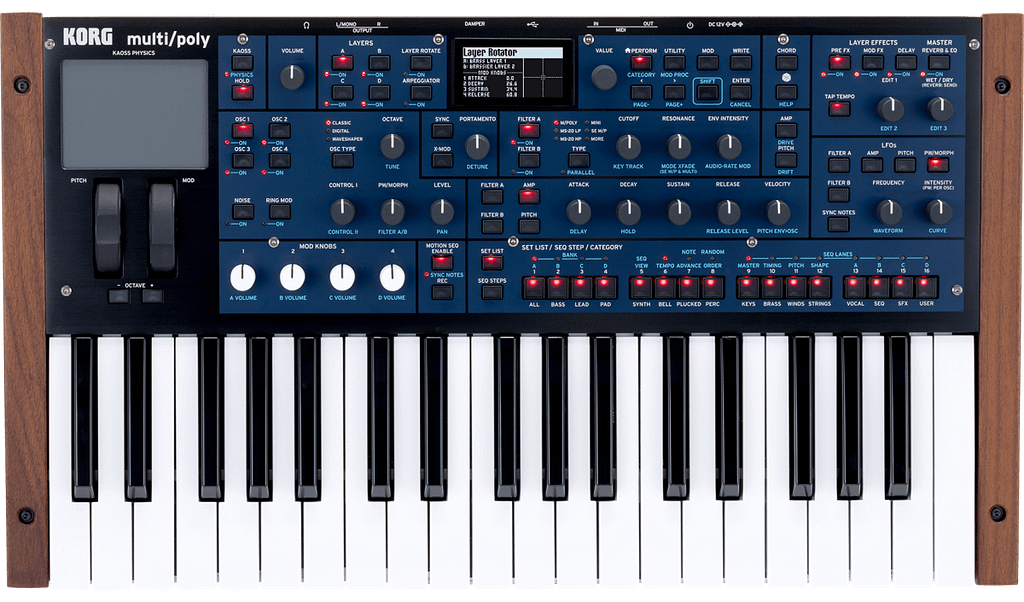
The multi/poly is built to feel like a premium instrument. It features a solid aluminum front panel, wooden side panels, and a striking blue-on-black aesthetic that clearly references the original Mono/Poly. The new semi-weighted keybed is smooth, expressive, and well suited for both synth leads and complex chordal playing.
Knobs offer firm resistance for precise control, and the panel layout is dense but logically arranged, with oscillators, filters, envelopes, LFOs, and performance controls all easily accessible. Despite the instrument’s depth, the design strongly encourages hands-on exploration rather than menu dependence.
Next-Generation Analog Modeling Engine
At the core of the multi/poly is a new analog modeling architecture that goes far beyond static emulation. Each voice includes a Virtual Voice Card, which models subtle variations in oscillators, filters, envelopes, VCAs, LFOs, and portamento circuits—just as real analog components would differ from voice to voice.
These voice cards continue to “run” even when not actively heard: envelopes keep evolving, oscillators maintain phase, resonance continues ringing, and pitch drift subtly accumulates over time. The result is a sound that feels alive, organic, and continuously evolving, closely mimicking the behavior of vintage analog hardware while remaining fully controllable.
Oscillators and Sound Generation
Each Program starts with four oscillators, plus a noise generator, ring modulation, oscillator sync, and cross-modulation (x-mod). These can be combined in complex ways inspired by modular synthesis, allowing East Coast, West Coast, and wavetable-style approaches to coexist within a single patch.
Virtual voice drift, envelope curvature models, and oscillator phase behavior add depth and unpredictability, while still allowing users to dial in precision when desired. This makes the multi/poly equally capable of massive stacked leads, rich evolving pads, and experimental textures that would traditionally require a large modular system.
Dual Modeled Filters
One of the multi/poly’s defining strengths is its dual-filter architecture, offering two independent filter slots per Program, configurable in series or parallel. The instrument includes a wide selection of newly modeled filters, each with authentic saturation and resonance behavior.
Available models include:
- M/Poly (classic Mono/Poly character)
- Mini ladder filter with bass-compensated resonance
- Pro filter inspired by early programmable polysynths
- MS-20 LP and HP (Korg 35) filters
- 2-pole SE M/P filter with continuous mode blending
- Linear 2-pole and 4-pole LP, HP, BP, and BR filters
- Multi Filter for simultaneous, modulatable mode blending
Audio-rate modulation, per-source filter balance, stereo routing, and post-filter drive open up an enormous range of tonal sculpting possibilities.
Modulation and Control Depth
Modulation is an area where the multi/poly truly excels. Each Program includes:
- 4 loopable DAHDSR envelopes
- 5 LFOs
- 6 Mod Processors
At the Performance level, additional Mod Processors, master reverb, EQ, and global controls are available. In total, the synth offers over 5,500 modulation destinations, including the ability to modulate individual Motion Sequence steps.
The four programmable Mod Knobs provide macro-style control over multiple parameters simultaneously, making complex modulation accessible in live performance. Nearly every front-panel control and on-screen parameter can serve as a modulation destination.
Motion Sequencing 2.0 and Layer Rotate
The multi/poly incorporates Motion Sequencing 2.0, an advanced evolution of Korg’s sequencing concept. Timing, pitch, shape, and step values are separated into independent lanes, each with its own loop points, randomization, and modulation options. This allows sequences to evolve organically and respond differently on every note or chord.
At a higher structural level, Layer Rotate introduces round-robin cycling of entire Programs across four Layers. Each key press can trigger different Programs in repeating or random order, creating constantly shifting textures, rhythmic complexity, and generative-style performance possibilities.
Kaoss Physics and Performance Expression
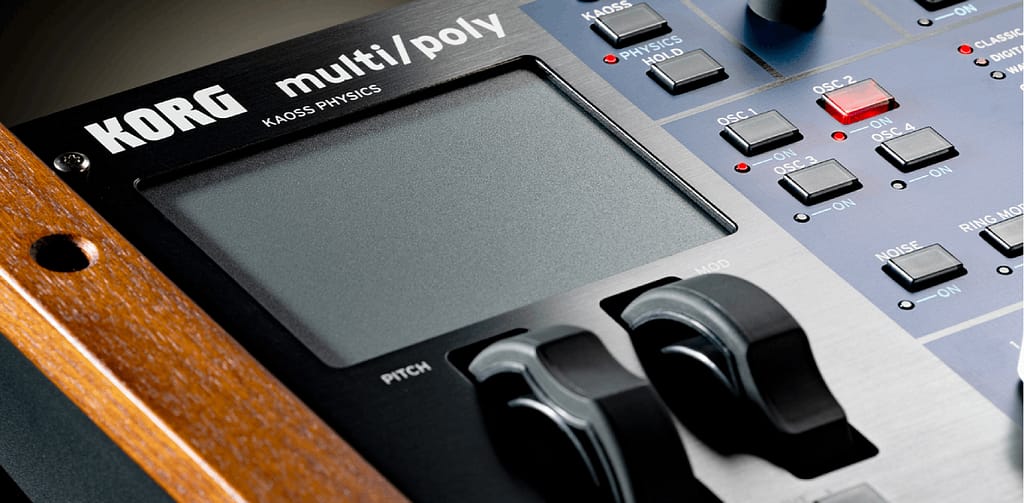
Kaoss Physics transforms the familiar X/Y pad into a physically modeled modulation system. A virtual ball rolls, bounces, accelerates, and interacts with walls and obstacles, generating eight continuous modulation signals based on its movement.
These signals can control virtually any parameter, creating expressive, gesture-driven modulation that feels both playful and deeply musical. Combined with pitch bend, modulation wheels, Mod Knobs, and the Hold function, the multi/poly offers multiple layers of real-time expression.
Effects and Production Tools
Each Layer includes three insert effects, plus a send to a master reverb and a master parametric EQ. The effects library is extensive, ranging from standard processors to distinctive and modeled effects derived from Korg’s OASYS and Kronos platforms.
Additional production tools include:
- Intelligent randomization via a dedicated Dice button
- Set Lists for performance organization
- Smooth Sound Transitions, allowing effects and voices to decay naturally when switching sounds
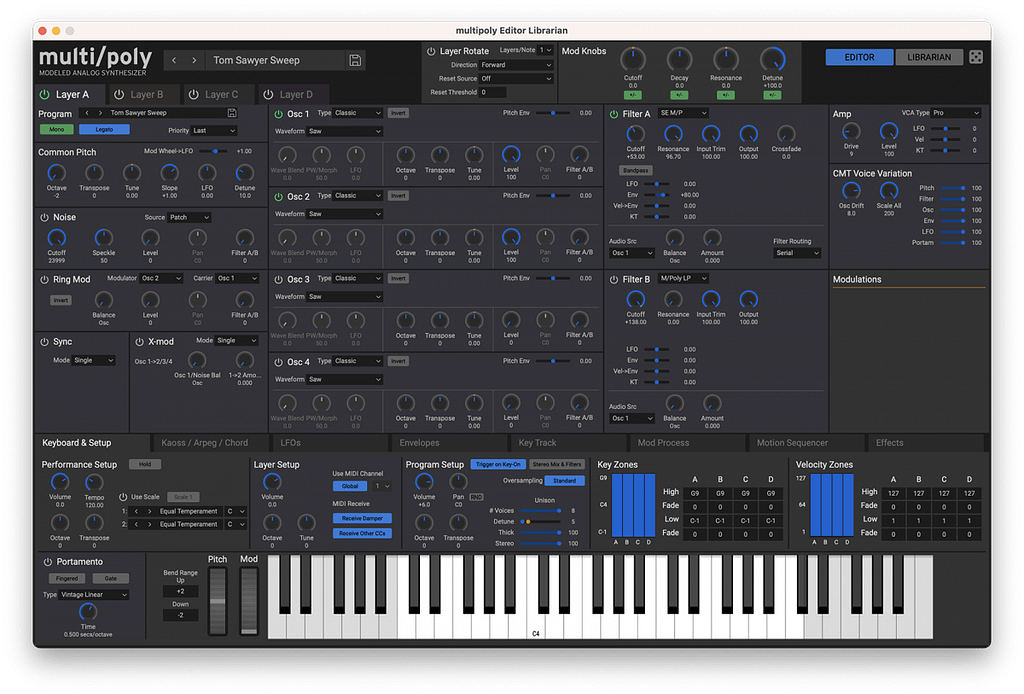
An Editor/Librarian for macOS and Windows provides deep editing and real-time modulation visualization without the need for data transfers.
Connectivity
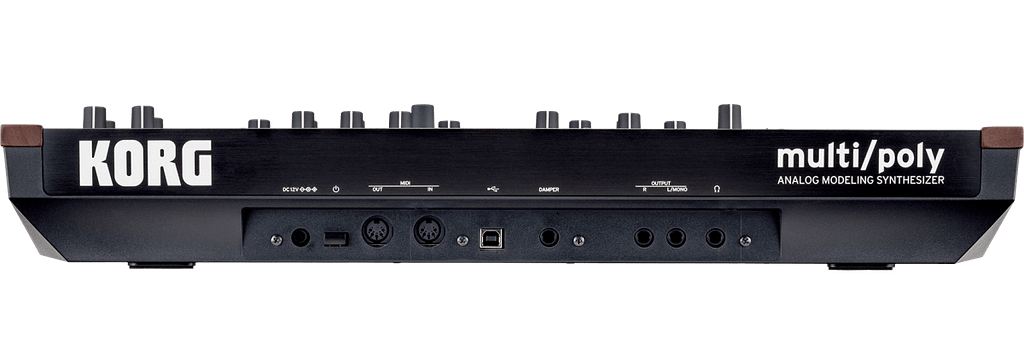
The multi/poly includes:
- Balanced stereo outputs
- Stereo headphone output
- MIDI In/Out (DIN)
- USB class-compliant MIDI
These connections make it equally suitable for studio integration and live performance setups.
Advantages
- Exceptionally deep and realistic analog modeling
- Virtual Voice Cards create organic per-voice variation
- Massive modulation system with over 5,500 destinations
- Dual-filter architecture with extensive modeled filters
- Motion Sequencing 2.0 enables evolving, generative patterns
- Layer Rotate unlocks unique polyphonic round-robin behavior
- Kaoss Physics adds expressive, gesture-based modulation
- High-quality effects and performance features
- Premium build quality and expressive keybed
Limitations
- Digital-only architecture may deter analog purists
- Depth and complexity create a steep learning curve
- Dense interface can feel overwhelming at first
- Best results require time and exploration rather than instant gratification
Verdict
The Korg multi/poly is not just a tribute to a classic—it is a bold redefinition of what digital analog modeling can achieve. By simulating not only analog sound, but analog behavior at a component level, Korg has created an instrument that feels alive, expressive, and endlessly exploratory.
This is a synth designed for players who want to dive deep, experiment freely, and push beyond conventional subtractive synthesis. While its complexity may intimidate beginners, those willing to invest time will be rewarded with one of the most powerful and musically inspiring synth engines available today.