
An 8-Voice Analog Bi-Timbral Flagship That Redefines the Modern Moog
The Moog Muse is an eight-voice, bi-timbral, fully analog polyphonic synthesizer that brings together more than five years of Moog’s research, circuit refinement, and musical design. Positioned as a studio and performance centerpiece, Muse blends the unmistakable Moog analog sound with forward-thinking digital control, deep modulation, an advanced sequencer, and a distinctive Diffusion Delay™ processor.
It stands as one of Moog’s most ambitious modern analog keyboards, combining discrete oscillators derived from the Minimoog Voyager with a saturating CP3 mixer, dual transistor ladder filters, stereo VCAs, and a rich macro-driven modulation environment.
Rating: ★ 9.5 / 10
Based on critical reception across the synthesizer community, industry evaluations, and the extensive capabilities described in your document, the Moog Muse stands as one of the most advanced analog polyphonic instruments available today. It scores exceptionally high in:
- Sound quality
- Modulation depth
- Build and playability
- Innovation (Diffusion Delay, hybrid workflow)
- Expressiveness (aftertouch, voice architecture)
The only factors preventing a full 10/10 score are its premium price and physical size, which may limit accessibility.
Design and Build Quality
Muse is built for serious musicians and sound designers. Its 61-key Fatar semi-weighted keybed includes velocity and channel aftertouch, offering an expressive interface that complements its deep analog architecture.
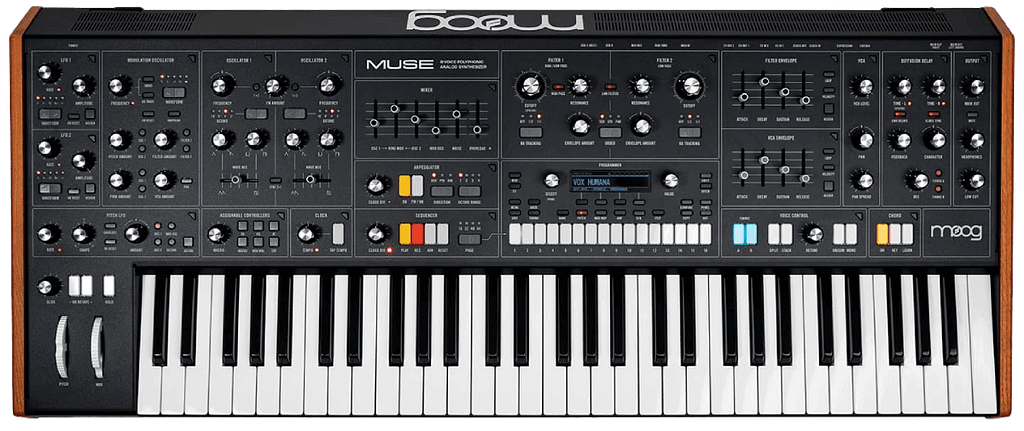
The front panel features:
- 44 knobs, 16 sliders, 129 buttons,
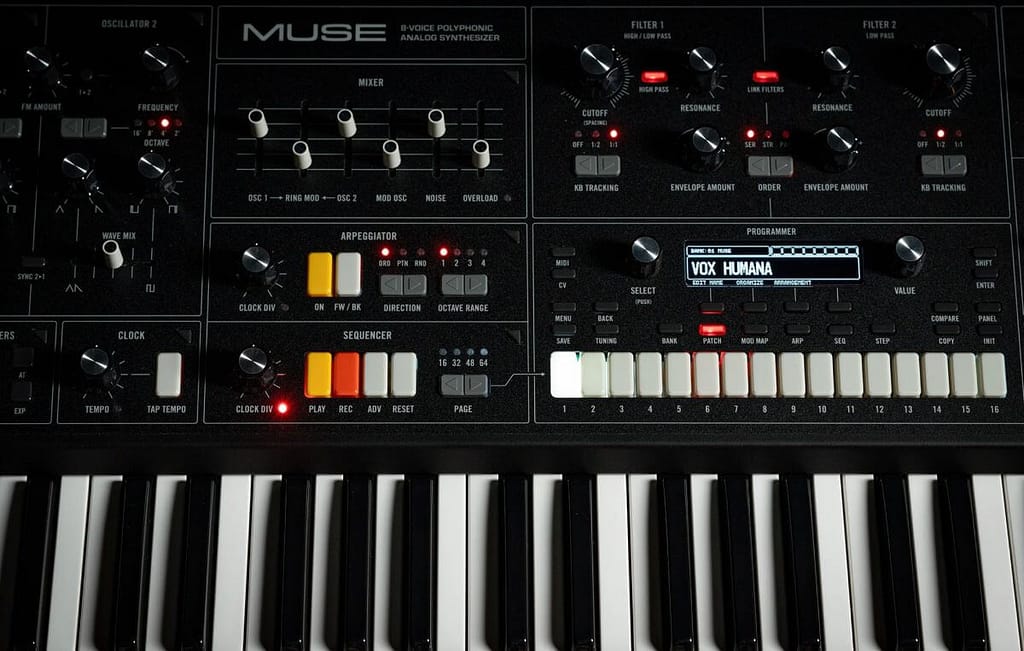
- A bright OLED screen,
- A true knob-per-function approach supported by contextual “More” menus.
This hybrid workflow maintains immediacy while allowing deeper access to modulation slots, routing options, and timbral settings without losing musical flow.
The instrument feels substantial at 32 lbs and measures 39 × 17 × 4.5 inches — a reassuringly solid build expected from a flagship Moog synthesizer.
Analog Architecture and Sound Engine
At its core, Muse is a powerful eight-voice analog system, with each voice featuring:
- 2 discrete VCOs (triangle/saw mix, pulse with variable width, octave switching)
- A dedicated Modulation VCO with audio-rate capability
- Analog ring modulation
- White noise generator
- Saturating CP3-style mixer with Overload circuit
- Dual Moog transistor-ladder filters (one switchable HP/LP)
- Stereo discrete VCAs with tremolo/panning options
This configuration gives Muse a remarkable degree of tone-shaping power. It can move from pristine, classic Moog bass and lead sounds to wide, evolving pads, gritty textures, percussive FM plucks, and experimental modulated tones.
A key strength is that Muse has a distinct Moog character without being locked into a single recognizable timbre. Its sounds hold together across the keyboard range — from deep sub-bass to high harmonics — avoiding the tonal drift or narrowing common in many analog polysynths.
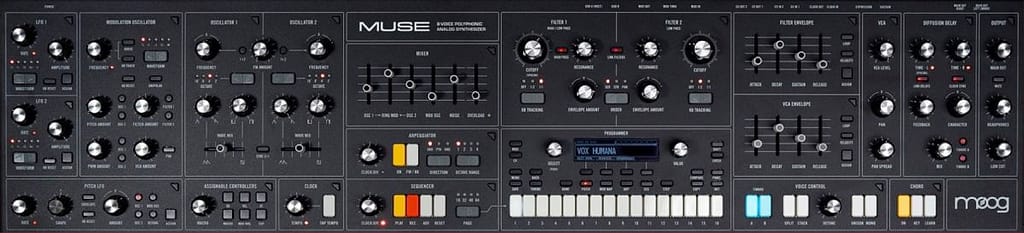
Modulation, Bi-Timbrality, and Performance Controls
Muse is as much a modular-inspired instrument as a polyphonic keyboard. Each patch features:
- 16 modulation slots per timbre,
- Assignable envelopes,
- Two LFOs plus a dedicated Pitch LFO,
- Advanced glide,
- Flexible FM between oscillators,
- A programmable macro knob,
- And extensive routing transforms for shaping modulation curves.
Its bi-timbral engine allows:
- Layering two timbres,
- Splitting the keyboard,
- Assigning voices,
- And shaping each timbre independently within a single patch.
Voice stealing, detune, mono/stacked modes, and unison behaviors allow highly specific performance configurations.
The 61-key Fatar keybed with aftertouch, pitch + mod wheels, octave switches, and pedal inputs makes the Muse extremely playable in both studio and live contexts.
Diffusion Delay™ Processor
One of Muse’s defining features is the stereo Diffusion Delay, inspired by vintage digital rack delays but reimagined with:
- Diffusion
- Multi-tap structures
- Resonant filtering
- Feedback character shaping
- Analog bypass for uncompromised analog tone
A recent firmware update adds six global modulation sources for dynamic delay manipulation, enabling chorus-like shifting, randomized diffuse spaces, rhythmic send automation, and aftertouch-driven feedback.
This effect alone significantly expands the instrument’s sound-design landscape.
Sequencer, Arpeggiator, and Creative Workflow
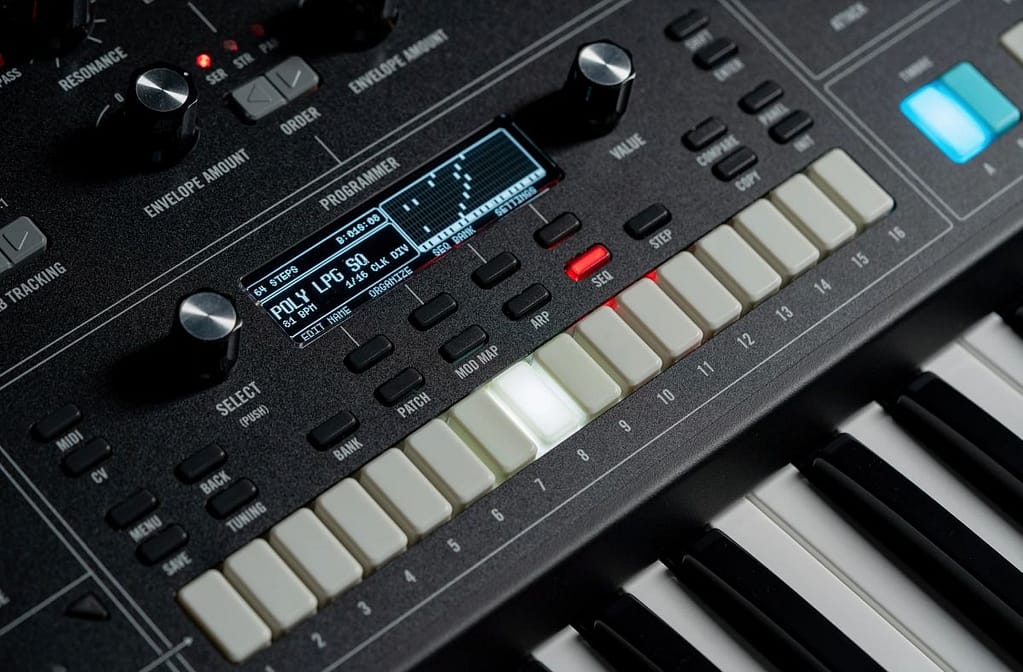
Muse includes a 64-step polyphonic sequencer with 16 banks of 16 sequences. Parameter automation, probabilistic functions, per-step editing, and modulation sequencing make it suitable for generative sound design and performance-ready patterns.
The arpeggiator supports extensive rhythmic and melodic programming, octave ranges, patterns, and gate shaping.
Together, these features allow Muse to function as a standalone production tool, capable of composing full pieces without external sequencing.
Sound
Muse is capable of an exceptionally wide range of tones. It can deliver familiar Moog basses, soaring leads, and lush pads — but it also excels at not sounding like a typical Moog. According to the user impressions in your document:
- It maintains a signature Moog richness without limiting itself to a single sonic identity.
- Patches hold up across the keyboard — unusual for many analog poly synths.
- It shines when pushed into gritty, unstable, distressed textures, thanks to the noise generator and Overload circuit.
- The synth responds musically even when pushed far outside classic Moog territory, encouraging experimental sound design.
It is rare to find an analog poly that can convincingly handle percussion, electric-piano-like patches, transitions, evolving pads, and sub-bass all from one architecture. Muse accomplishes this with ease.
Advantages
- True 8-voice analog architecture with discrete oscillators, dual filters, and stereo VCAs
- Bi-timbral engine for splits, layers, and complex performance setups
- 61-key Fatar keyboard with velocity and aftertouch for expressive play
- Powerful Diffusion Delay™ with deep modulation potential
- Extensive modulation matrix and routing flexibility
- “Knob-per-function” layout with smart “More” menus
- Excellent sound quality: expressive, wide-ranging, and not confined to stereotypical Moog tones
- Advanced sequencer and arpeggiator with parameter recording and generative features
- Expandable preset architecture with 256 patch memories
- Beautifully built, professional instrument suitable for stage and studio
Limitations
- Large and heavy compared to other modern polysynths
- Fully analog architecture plus deep digital control places it at a premium price point
- Complex modulation environment may present a learning curve to new users
- No onboard multitimbral effects beyond Diffusion Delay (though analog signal remains pristine)
- Requires external gear for deeper DAW integration if used as a centerpiece instrument
Verdict
The Moog Muse is not just another analog polysynth — it is a flagship-level instrument that successfully merges Moog’s legacy with modern flexibility, modulation power, and contemporary workflow enhancements. With its expressive keybed, bi-timbral design, powerful sequencer, and stunning Diffusion Delay processor, Muse is equally at home on stage, in sound design studios, film scoring environments, and hybrid electronic setups.
Its rich, versatile sound and forward-thinking architecture establish it as one of the strongest synthesizers Moog has ever produced — and one of the best analog polysynths available today.