
A Faithful Semi-Modular Analog Synth with Modern Enhancements
The Behringer 2600 is a modern reimagining of the legendary ARP 2600 semi-modular synthesizer, offering authentic analog sound and modular flexibility at a fraction of the cost of the original. Designed for musicians, sound designers, and analog enthusiasts, it captures the essence of the classic 1970s instrument while adding contemporary features such as MIDI, USB connectivity, and LED-illuminated controls.
With its three voltage-controlled oscillators, dual filters, spring reverb emulation, and semi-modular patching system, the Behringer 2600 bridges vintage tone with modern workflow in a portable, rack-mountable format.
Design and Build Quality
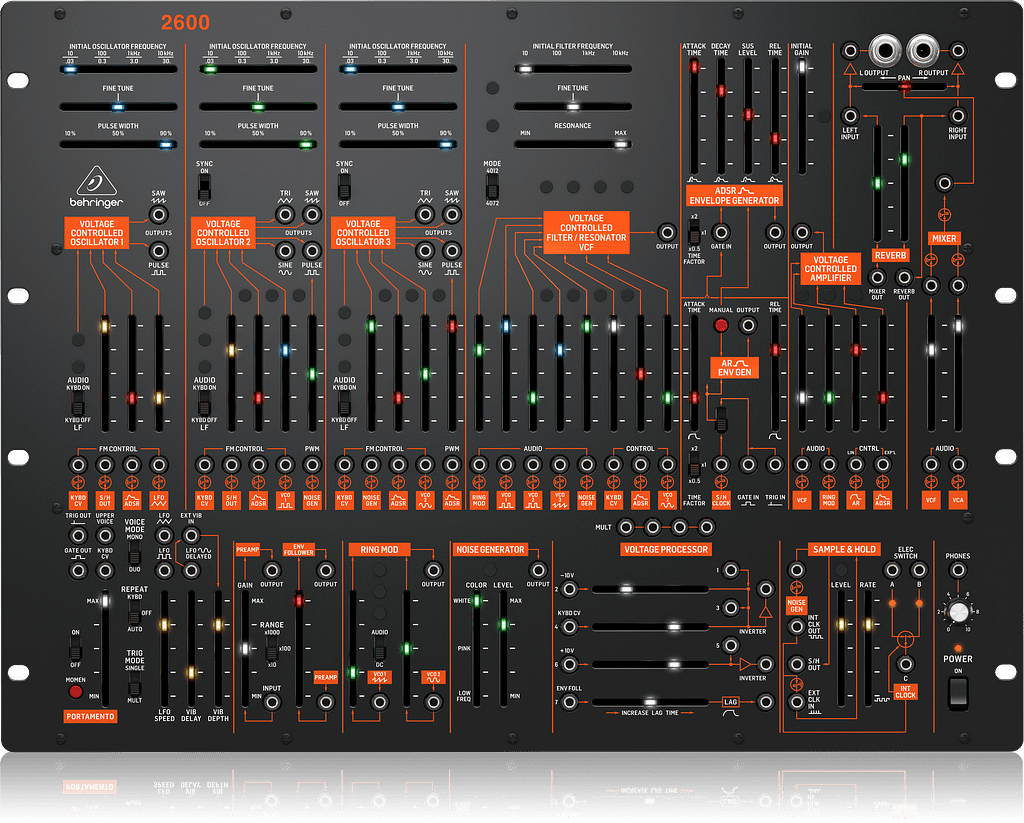
The Behringer 2600’s design pays close homage to the original ARP 2600 while introducing thoughtful updates for modern users. The semi-modular architecture means it can be played immediately without patching but allows deep experimentation through its patch points.
The unit features a robust metal chassis with high-quality sliders illuminated by LEDs for visibility in studio or stage environments. Each section — oscillators, filter, envelope, mixer, and effects — is clearly laid out, making it approachable for both newcomers to analog synthesis and experienced modular users.
While physically smaller than the original ARP 2600, the Behringer version retains a solid, professional feel. The portability is a significant advantage for modern producers who need classic analog sound in a more manageable size.
Sound Engine and Features
At its core, the Behringer 2600 is a true analog synthesizer with discrete circuitry based on the original design. It features:
- Three VCOs with multiple waveforms and sync capabilities
- A ring modulator, sample & hold, and noise generator
- Voltage-controlled filter (VCF) switchable between 4012 and 4072 designs
- Voltage-controlled amplifier (VCA) with envelope and control modulation
- Built-in analog spring reverb emulation
- Portamento, LFO, and voltage processor sections
The dual filter modes are a major highlight, allowing users to toggle between the warm, rounded tone of the early 4012 circuit (inspired by the Moog-style ladder filter) and the sharper, more pronounced 4072 filter found in later ARP models.
The synth includes 83 patch points, supporting full modular routing and external CV integration. MIDI and USB connectivity add modern control options for sequencing and automation within a DAW environment.
Sound Quality and Performance
The Behringer 2600 delivers a rich, analog tone that closely mirrors the depth and complexity of the original ARP 2600. The oscillators are stable and full-bodied, capable of everything from deep, resonant basses to bright, cutting leads and evolving textures.
The filter section is especially expressive — the 4012 mode offers smooth warmth suited to classic analog sweeps, while the 4072 mode adds bite and presence for modern productions. The VCA and envelopes are responsive and musical, contributing to the instrument’s organic feel.
The built-in reverb emulation adds dimension to patches, capturing the character of the original spring unit without the mechanical noise. Overall, the sonic range is broad — from vintage analog tones to experimental modular soundscapes.
Connectivity
- 83 patch points for modular routing
- MIDI In/Thru and USB-MIDI interface
- Balanced XLR and ¼-inch outputs
- External audio input for processing other signals through the filter and effects
- CV/Gate I/O for connection with Eurorack systems or other analog gear
Advantages
- Authentic analog sound inspired by the ARP 2600
- Dual switchable filters (4012 and 4072)
- Semi-modular design — playable without patching but fully flexible
- LED-illuminated sliders and modern MIDI/USB integration
- High build quality with extensive patching options
- Excellent price-to-performance ratio
Limitations
- Built-in reverb lacks the full character of a real spring unit
- Large footprint compared to compact synths
- No built-in sequencer or patch memory
- External keyboard required (no onboard keys)
Verdict
The Behringer 2600 succeeds in recreating the magic of one of the most iconic analog synthesizers ever made. It captures the sonic character, playability, and flexibility of the ARP 2600 while adding the convenience of modern connectivity and compact form.
For musicians seeking an authentic analog experience without the vintage price tag, the Behringer 2600 is a remarkable achievement. It offers classic sound design depth, modular creativity, and performance-ready features that make it suitable for both studio and stage use.