
A Hybrid Semi-Modular Synth Built for Exploration
The Behringer GRIND is a compact, affordable hybrid analog/digital semi-modular synthesizer that expands Behringer’s Producer Series alongside Crave, Edge, and Spice. Designed as a versatile sound design tool, GRIND combines a wide selection of digital oscillator engines with a classic 24 dB analog ladder filter, onboard sequencing, and a generous patchbay for modular-style routing.
Positioned as a creative bridge between digital synthesis flexibility and analog tone shaping, GRIND targets producers and performers who want access to a broad sonic palette—ranging from percussion and basslines to drones and experimental textures—without committing to a full modular system.
Our Rating: ★ 8.5 / 10
Design and Build Quality
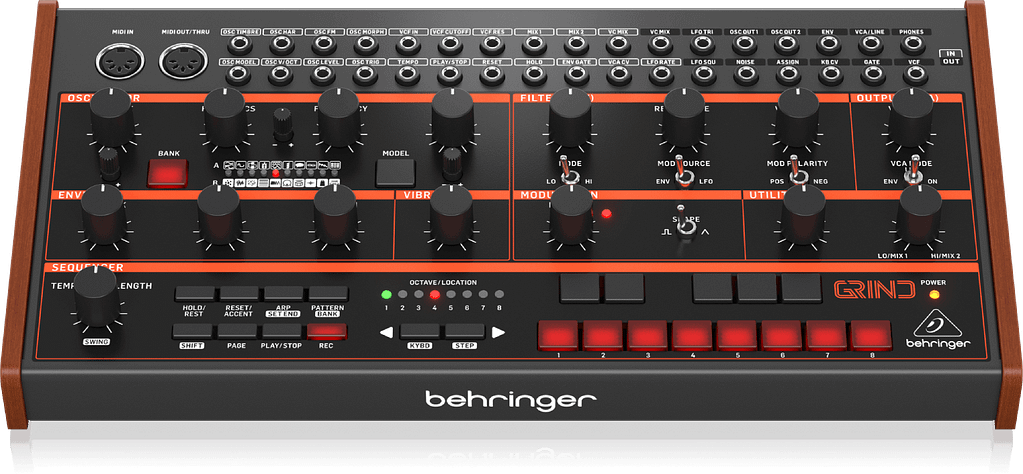
GRIND adopts a compact desktop form factor consistent with Behringer’s Producer Series. Its lightweight chassis makes it easy to integrate into small studios or portable setups, while the panel layout is designed for immediate access to core sound-shaping controls.
The front panel combines buttons for engine and bank selection with dedicated knobs and switches for oscillator shaping, filtering, envelope control, and modulation. A standout feature is the 34-point patchbay, which opens GRIND up to deeper experimentation and integration with Eurorack or other semi-modular gear.
Hybrid Sound Engine
At the heart of GRIND is its hybrid architecture, pairing 24 digital sound engines with an analog signal path. The digital oscillator section includes a diverse range of synthesis models, many inspired by Mutable Instruments’ Plaits—whose code was released as open source—alongside additional synthesis types.
Available engines include virtual analog, wavetable, additive, waveshaping, FM, Karplus-Strong, granular-style textures, noise-based engines, and emulations inspired by Yamaha DX7 and Roland TR-303-style bass sounds. Morphing controls allow each engine to shift character dynamically, making it possible to move between radically different timbres within a single patch. Reviews-GRIND synthe
This wide engine selection gives GRIND a chameleon-like quality: it can behave as a digital percussion source, a bass synth, a texture generator, or an experimental noise machine depending on how it’s configured.
Filter, Envelope, and Modulation
GRIND’s digital oscillator feeds into a 24 dB/octave analog ladder filter, providing the warmth and musical response typically associated with classic subtractive synthesis. The filter can be switched between low-pass and high-pass modes, with controls for cutoff, resonance, and modulation depth.
Modulation is intentionally straightforward:
- A single fully analog LFO with triangle and square waveforms
- A standard ADSR envelope
- Modulation routing selectable between envelope or LFO, with polarity control
While basic on paper, this simplicity pairs well with the patchbay, where modulation signals can be re-routed, combined, or extended using external CV sources.
Sequencer and Performance Tools
GRIND includes both a 32-step sequencer and an arpeggiator, making it performance-ready straight out of the box. The sequencer supports swing, rests, and interactive step editing, and can store up to 64 patterns across 8 banks.
Patterns can be created either in Keyboard mode or Step mode, allowing users to compose traditionally or experiment while the sequence is running. While not deeply complex, the sequencer is well suited to rhythmic exploration and looping ideas, particularly when paired with the wide variety of oscillator engines.
Semi-Modular Patchbay and Connectivity
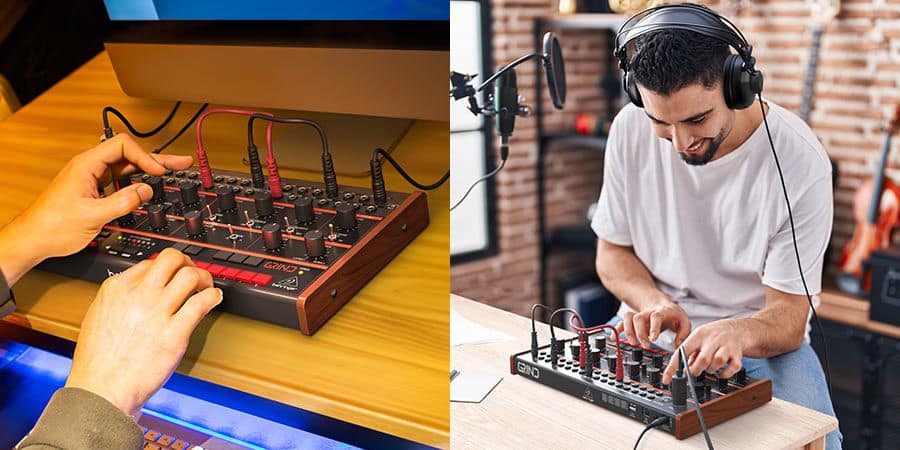
The 34-point patchbay is central to GRIND’s identity. It allows users to override default routing, apply external modulation, and integrate GRIND into a Eurorack or hybrid hardware setup.
Connectivity includes:
- MIDI In, Out, and Thru (5-pin DIN)
- Class-compliant USB MIDI
- CV, Gate, Trigger, and Clock I/O
- Two 3.5 mm audio outputs
- Headphone output
Although monophonic, GRIND supports poly-chaining with additional Behringer synths, allowing up to 16 voices to be controlled from a single MIDI controller.
Sound Character
GRIND’s sound character is defined more by variety and experimentation than by a single sonic identity. The digital engines provide everything from clean, precise tones to unstable, noisy, and percussive textures, while the analog ladder filter helps unify those sounds with warmth and weight.
It excels at exploratory sound design, unusual timbres, and rhythmic experimentation. While it can produce traditional basslines and leads, its strongest appeal lies in its ability to shift between synthesis styles quickly and unpredictably.
Advantages
- Hybrid architecture combining diverse digital engines with an analog ladder filter
- Wide selection of oscillator models inspired by Mutable Instruments Plaits
- 34-point semi-modular patchbay for deep experimentation and modular integration
- Built-in 32-step sequencer and arpeggiator
- Poly-chaining support for expanded polyphony
- Strong connectivity including MIDI, USB, and CV/Gate
- Compact, lightweight, and affordable
- Excellent value for a sound-design-focused hybrid synth
Limitations
- Monophonic operation without poly-chaining
- Modulation section is relatively basic without external patching
- No onboard effects
- Desktop-only format (no keyboard)
- Digital engine character may not appeal to purists seeking fully analog sound
Verdict
The Behringer GRIND is a creatively ambitious hybrid synthesizer that offers far more sonic flexibility than its size and price suggest. By combining a large collection of digital sound engines with an analog filter and a semi-modular patchbay, it encourages experimentation and rewards curious users.
While it isn’t designed to replace a traditional analog polysynth or a deep modular system, GRIND succeeds as an affordable, exploratory instrument that can expand almost any hardware setup. For producers interested in hybrid synthesis, modular workflows, and hands-on sound design, it represents one of the most compelling value propositions in Behringer’s current lineup.