
Compact Prophet-Inspired Analog Poly Synth at an Accessible Price
he Sequential Fourm is a four-voice, 100% analog polyphonic synthesizer that aims to deliver classic Prophet-style tone and workflow at a far more attainable price point. With a street price around £799 / $999 / €950, it sits in a segment often occupied by budget analog and “clone” instruments, but brings genuine Sequential design, sound, and build quality.
Fourm’s architecture is clearly inspired by the Prophet-5 and Pro One, combining a familiar subtractive signal path with modern conveniences such as preset storage, auto-calibration, USB connectivity, and a polyphonic aftertouch keybed.
For players who have long wanted “that Sequential sound” without flagship-level pricing, Fourm is positioned as one of the most competitive options in today’s analog polysynth market.
Design and Build Quality
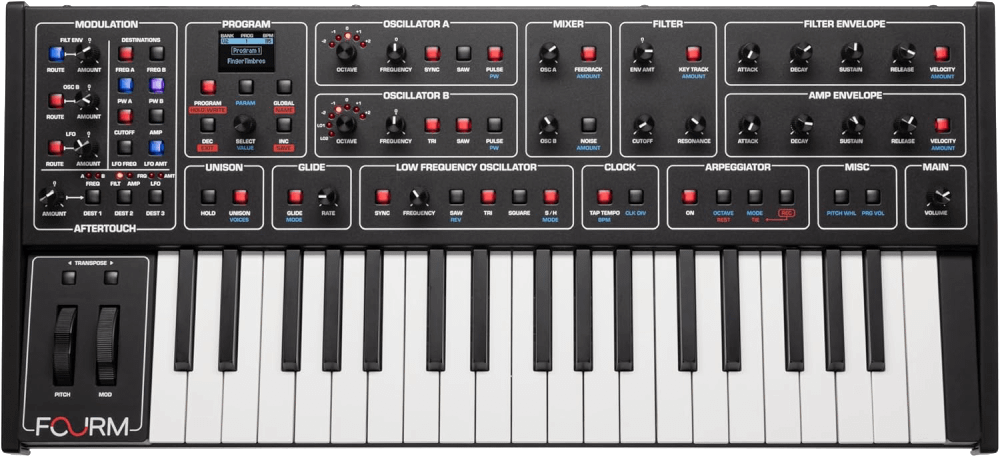
Fourm is housed in a mid-sized steel chassis that feels notably solid for its footprint. The overall impression is closer to a compact 70s/80s monosynth than a lightweight modern controller.
The front panel follows classic Sequential layout logic: oscillators, mixer, filter, envelopes, LFO, and modulation are laid out in a way that will immediately make sense to anyone familiar with Prophet-style instruments. Most primary parameters have their own knobs or switches, reinforcing the “reach and tweak” experience that analog synth users expect.
The keyboard is Sequential’s custom “Tactive” keybed, with:
- Three octaves
- Mid-sized keys (larger than mini-keys, smaller than full size)
- Velocity sensitivity
- True polyphonic aftertouch
The action is described as smooth and well balanced, and the inclusion of native polyphonic aftertouch at this price point is a standout feature.
On the rear panel, Fourm provides:
- MIDI in, out, thru
- USB port for computer connection
- Mono line output
- Headphone output
- Single pedal input (expression or footswitch)

Analog Architecture and Sound Engine
Fourm’s signal path is fully analog, closely following Prophet lineage in both structure and feel. The core sound engine includes:
- 2 VCOs (voltage-controlled oscillators)
- Saw and pulse waves on both
- Triangle wave available on Oscillator B
- Classic hard sync (Oscillator A sync to B)
- Oscillator B switchable to LFO mode (static or key-tracking)
- Noise generator
- Mixer
- Balances the two oscillators
- Adds noise
- Provides feedback for additional drive and thickness
- 4-pole resonant low-pass filter
- Inspired by Prophet rev 1/2 characteristics
- Smooth, rich response with self-oscillation capability
- VCF bass compensation to retain low end when resonance is increased
The VCF bass compensation is a notable design decision: it deviates from the behavior of many classic filters (including vintage Prophets), where bass tends to thin out as resonance rises. Purists may see this as less “authentic,” but in practical terms it makes Fourm a more capable bass synthesizer, preserving weight and impact even with resonant filter sweeps.
Envelopes and Modulation
- Two ADSR envelopes
- One dedicated to the amplifier
- One hard-wired to the filter, and available as a modulation source
- Response designed to match the feel of Prophet envelopes
- LFO
- Saw, triangle, square, and sample-and-hold waveforms
The modulation system follows a Pro One-style scheme, prioritizing immediacy over deep, menu-based modulation matrices.
Main modulation sources:
- Filter envelope
- Oscillator B (including when used as an LFO)
- LFO
- Polyphonic aftertouch
These sources can be routed to various destinations using a simple button matrix and an Amount control. The modulation routing allows:
- Direct modulation from the source
- Mod wheel–controlled modulation
- A combination of both (indicated via color states on the panel)
Polyphonic aftertouch has its own dedicated destinations, including:
- Oscillator frequency (A and/or B)
- Filter parameters
- Amp envelope
- LFO frequency and amount
This gives Fourm a level of expressive control rarely seen at this price point, particularly valuable for players who want nuanced, per-note modulation.
Performance Features
- Unison mode
- Choice of unison voice count
- Detune amount
- Optional auto-chord feature for instant stacked chords on a single key
- Vintage parameter
- Introduces controlled randomness to elements such as tuning and filter cutoff
- Emulates the behavior of older, less tightly calibrated analog hardware
- Arpeggiator / Sequencer
- Can act as a standard arpeggiator
- Or as a step sequencer up to 64 steps
- Supports both note and modulation sequences
There are no onboard digital effects, by design. This preserves a fully analog signal path and avoids extra A/D–D/A conversion. Users are expected to provide external reverbs, delays, or modulation effects if needed, which is consistent with the instrument’s purist analog positioning.
Interface, Menus, and Presets
The Sequential Fourm offers a largely hands-on interface that follows the classic Sequential philosophy: give the player direct control over the parameters that matter most. The oscillators, filter, envelopes, and modulation sections are all laid out logically, and the majority of functions have their own dedicated knobs or buttons. This makes real-time adjustment intuitive and keeps the synthesis workflow fast and musical.
Fourm also incorporates modern digital conveniences without compromising its analog personality. Program storage, global settings, voice calibration, and several secondary parameters are accessed through a small display paired with a single Select/Value rotary encoder. Although any form of menu navigation can be unwelcome on an analog synth, Sequential has implemented a thoughtful system to minimize disruption. Many buttons feature secondary labels in blue, and holding one of these buttons instantly calls up the relevant page on the display. This means deeper functions remain easily accessible without affecting performance flow.
Preset browsing is also handled through the screen, with factory sounds and user patches organized cleanly into banks of 128 programs each. Navigation is straightforward: select a category, then audition the sounds within it. While this hybrid approach doesn’t fully eliminate menu interaction, it strikes a comfortable balance between immediacy and modern functionality, helping the Fourm remain enjoyable to use while still offering a solid amount of digital control.
Sound and Presets
The Fourm’s preset library is organized by sound category, making it simple to jump directly to pads, basses, strings, organs, leads, or keys before exploring the individual patches within each group. This layout encourages more meaningful navigation, particularly since browsing numerically through the presets can give the impression that many sounds are similar. When accessed through categories, however, the depth and variety of the instrument’s tonal palette becomes clearer.
Tonally, the Fourm delivers the richness, warmth, and presence associated with Sequential’s analog heritage. Pads are surprisingly full for a four-voice synthesizer, bass patches carry impressive weight thanks to the bass-compensated filter, and classic Prophet-style keys and organ tones are well represented. Even with limited polyphony, the synth manages to produce thick, expressive sounds that feel alive under the fingers.
Because the architecture is straightforward and the modulation system is easy to manipulate, users can quickly reshape presets into something personal. The oscillators, filter, and envelopes respond musically, and the addition of features like feedback, noise, unison detune, and Vintage behavior provide ample room for shaping character and movement. Overall, the factory presets demonstrate a clear focus on classic analog tone, while still offering enough range to showcase what the Fourm is capable of.
Advantages
- Fully analog signal path with classic Prophet-style tone and architecture
- Polyphonic aftertouch on the custom Tactive keybed for expressive performance
- Balanced layout with hands-on controls for core synthesis functions
- Straightforward modulation system inspired by the Pro One, offering fast, musical routing
- VCF bass compensation enhances low-end weight, improving bass performance
- Strong build quality with a compact steel chassis that feels solid and professional
- Modern conveniences such as USB connectivity, preset storage, and auto-calibration
- Rich, punchy sound character that stands out among analog polysynths in this price range
Limitations
- Only four voices of polyphony, limiting more complex chord or pad work
- No onboard effects, requiring external processing for ambience and modulation
- Some parameters require menu navigation despite the largely hands-on interface
- Mid-sized keys may not appeal to players who prefer full-size keybeds
- Bass-compensated filter behavior may feel less “authentic” to strict Prophet purists
Verdict
The Sequential Fourm delivers much more than its modest specifications and price might suggest at first glance. It offers:
- A pure analog, Prophet-inspired sound engine
- A genuinely expressive polyphonic aftertouch keybed
- A straightforward, musical modulation system
- A thoughtful balance between hands-on control and modern digital convenience
For players who have long wanted a Sequential instrument but were deterred by the cost of a Prophet-5, Prophet-6, or other flagships, Fourm is a compelling proposition. It captures the character, tone, and immediacy of classic Sequential designs while remaining easier to live with thanks to features like USB, auto-calibration, preset storage, and bass-compensated filtering.
Within its constraints — four voices, no effects, and some menu access — Fourm stands out as one of the most attractive analog polyphonic synths in its price range and a very credible entry point into the Sequential ecosystem.