
If you are shopping for a synth with best built in sequencer potential, the real question is not which unit has the most steps or the longest spec sheet. It is which sequencer makes you write better parts faster. Plenty of instruments offer note entry, motion recording, and pattern storage. Far fewer make sequencing feel like part of the instrument rather than a bolted-on feature.
That distinction matters because built-in sequencers shape how a synth gets used. Some are sketchpads. Some are performance engines. Some are deep enough to replace a separate hardware sequencer for entire tracks. If your goal is live electronic performance, the winner may not be the same synth you would choose for studio composition or hands-on sound design.
What makes a synth with best built in sequencer status?
A great sequencer is not just about track count. Workflow matters more. You want quick entry, clear editing, reliable pattern chaining, and enough modulation depth to make sequences feel alive instead of static. Parameter locks, probability, ratcheting, polymeter, and real-time recording all change what “good” means depending on your style.
For keyboard players, playability matters too. A sequencer can be powerful on paper and still be frustrating if basic tasks take menu-diving. For producers, integration matters – how easily patterns become songs, how motion automation is handled, and whether the synth invites experimentation without stopping the creative flow every two minutes.
With that in mind, a few instruments consistently rise to the top.
Best synth with built in sequencer picks
Sequential Pro 3
If the question is pure sequencing power inside a synth, the Sequential Pro 3 belongs near the front of the conversation. Its sequencer is deep, immediate, and unusually musical. You get up to 64 steps per sequence, multiple sequencer tracks, and extensive parameter sequencing that turns the instrument into a motion-heavy mono synth with modular-style behavior.
What makes the Pro 3 stand out is how tightly the sequencer connects to the sound engine. This is not just note data. You can animate filter movement, wavetable position, effect parameters, and modulation amounts in a way that feels compositional rather than technical. The result is a synth that can generate evolving basslines, aggressive rhythmic leads, and complex sequences with very little external gear.
The trade-off is obvious. It is expensive, and it is a mono/paraphonic instrument, not a full polyphonic workstation. If your music depends on chord sequencing from one keyboard, the Pro 3 may not be the most complete answer. If you want expressive, high-end sequencing inside a serious performance synth, it is one of the strongest options available.
Learn more about the Sequential Pro 3
Korg Minilogue XD
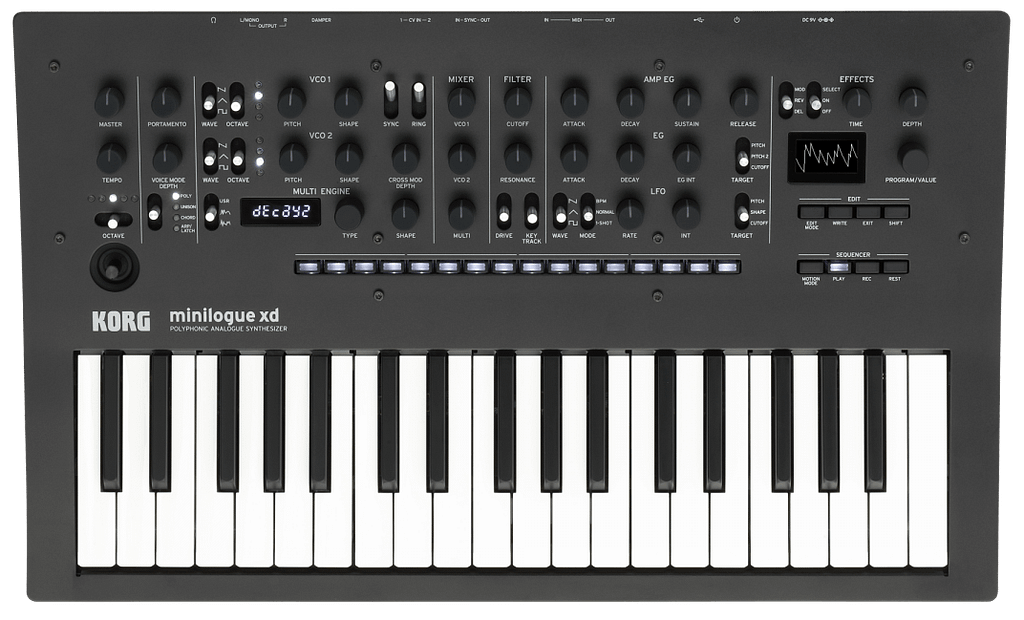
The Korg Minilogue XD is not the deepest sequencer here, but it remains one of the most balanced choices for actual buyers. Its 16-step polyphonic sequencer is easy to understand, quick to use, and much more musical than its modest specs suggest. Motion sequencing adds real value, especially for filter sweeps, oscillator shape changes, and effect animation.
This is a strong choice for players who want a synth first and a sequencer second, but still need enough onboard sequencing to write hooks, chord loops, and evolving patterns without reaching for a DAW. The interface is clean, the learning curve is reasonable, and the four-voice architecture makes it more harmonically useful than many mono synths with more advanced sequencers.
Its limitation is depth. If you need long pattern lengths, probability tools, or elaborate song construction, you will outgrow it. But for immediacy, sound quality, and price-to-workflow value, the Minilogue XD remains one of the smartest buys in the category.
Learn more about the Korg Minilogue XD
Novation Bass Station II with AFX/seq features
The Bass Station II is a reminder that a synth does not need a giant screen or workstation architecture to have a compelling built-in sequencer. Its step sequencer and arpeggiator are straightforward, performance-friendly, and especially strong for bass and lead work. The pattern workflow is fast, and the instrument encourages improvisation.
It is not the answer if you need polyphonic sequencing or broad arrangement capabilities. What it does offer is a reliable, tactile sequencer inside a genuinely strong analog monosynth. For acid, electro, techno, and modern bass-driven production, that is often enough.
This is also a case where value matters. The Bass Station II tends to compete well below the price of more ambitious sequencing synths, so it makes sense for buyers who want a serious analog voice with onboard pattern creation but do not need flagship complexity.
Learn more about the Novation Bass Station II
Arturia MiniFreak
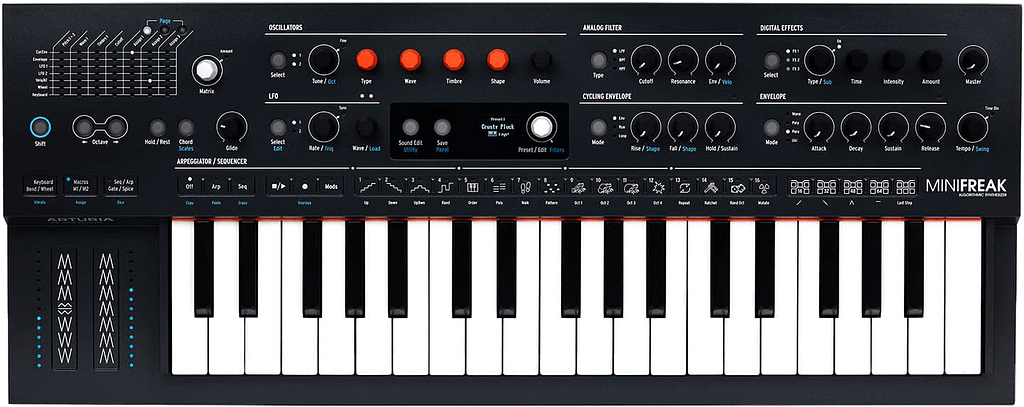
The Arturia MiniFreak deserves attention because it takes a modern hybrid synth engine and pairs it with sequencing tools that feel built for current producers. Its sequencer is not as deep as dedicated Elektron gear, but it is creative, inviting, and stronger than many keyboard synths in this price range. Spice and Dice functions can push patterns into fresh territory fast, which matters if you want happy accidents without complete chaos.
The MiniFreak works particularly well for writers who want rhythmically active melodic parts, animated textures, and fast experimentation. Because the engine itself is flexible, the sequencer ends up being a bigger part of the instrument’s identity than you might expect. It rewards users who like to mutate ideas in real time.
The downside is that some players will still prefer a more traditional step-entry workflow or longer, more detailed pattern editing. The MiniFreak is inspiring, but it leans more toward creative generation than deep sequencing architecture.
Learn more about the Arturia MiniFreak
Elektron Syntakt
Strictly speaking, the Elektron Syntakt sits in a gray area between synth and groovebox, but it would be hard to discuss the synth with best built in sequencer without mentioning Elektron. The sequencer is the reason many players buy into the platform at all. Parameter locks, conditional trigs, micro-timing, track independence, and performance-oriented pattern control make it one of the most sophisticated onboard sequencing environments available.
For producers building entire rhythmic frameworks from the hardware itself, Syntakt is exceptional. It handles drum programming, bass sequencing, melodic phrases, and pattern evolution with precision and speed once you learn the system. In live settings, it is one of the strongest tools in this space.
The catch is equally clear. If you want a traditional keyboard synth with immediate piano-style access, this is not it. The learning curve is real, and the interface philosophy is different from what many keyboard players expect. But if sequencing depth is your top priority, Elektron remains hard to beat.
Learn more about the Elektron Syntakt
Which one is actually best?
For most buyers, there is no single winner because “best” depends on what role the sequencer needs to play.
If sequencing is central to your composition process and you want a premium keyboard synth built around advanced pattern creation, the Sequential Pro 3 is the strongest specialist pick. If you want the best blend of sound, price, usability, and enough sequencing to stay productive, the Korg Minilogue XD is the safer recommendation. If your workflow is pattern-first and performance-driven, the Elektron Syntakt may outperform both, even if it stretches the definition of a keyboard synth.
The MiniFreak is a strong middle-ground option for modern producers who want creativity and variation more than strict linear control. The Bass Station II makes sense if your budget is tighter and your music lives in basslines, leads, and simple but effective analog sequences.
How to choose the right built-in sequencer for your workflow
The easiest mistake is shopping by features instead of friction. A sequencer with probability, automation lanes, and pattern memory looks impressive, but if entering notes feels slow, you will use it less. By contrast, a simpler sequencer that gets ideas down instantly can become the center of your writing process.
Think first about what you sequence most often. If it is monophonic bass and lead lines, a mono synth with a strong sequencer may be all you need. If you build chord progressions and layered harmonic loops, polyphony matters more than advanced trig conditions. If you play live, pattern switching and mute behavior matter more than raw step count.
Also consider whether the sequencer is there to replace other gear or complement it. Some musicians want one box that can carry a session. Others just need enough onboard sequencing to sketch ideas before moving to a DAW or external hardware. Those are very different buying scenarios, and they lead to different answers.
At SynthReview, we usually come back to one simple test: does the sequencer make the synth more playable, or does it feel like extra admin? The best instruments in this category blur that line. They let you program rhythm, melody, and motion while staying connected to the sound itself.
If you are choosing with your ears and your hands instead of the spec sheet alone, the right sequencer usually reveals itself fast. Pick the instrument that makes you want to write the next pattern immediately, because that is the one you will still be using after the honeymoon period ends.