
A great techno track can start with a kick and a loop, but the synth is usually where the identity shows up. If you are searching for the best synthesizer for techno production, the real question is not which model has the most hype. It is which instrument gives you the right mix of pressure, motion, control, and speed when you are actually building drums, basslines, stabs, drones, and tension.
Techno is broad enough that there is no single perfect answer. A Berlin-style producer working with evolving sequences needs something different from a warehouse-focused artist writing fast, punchy loop-based tracks. That is why the best buying decision usually comes down to workflow first, sound engine second, and only then feature count.
What makes the best synthesizer for techno production?
For techno, a synth has to do more than sound good in isolation. It needs to sit inside repetitive arrangements without getting boring. That usually means strong modulation, easy hands-on control, and a tone that can stay compelling across small changes in filter movement, envelope timing, oscillator drift, or effects depth.
Low-end behavior matters a lot. Techno basslines and tom-like percussive parts often live in a crowded range with the kick, so a synth that sounds huge on its own is not always the best fit in a mix. Tight envelopes, stable tuning, and the ability to shape harmonics precisely can matter more than raw size.
Sequencing also matters more here than in many other genres. Some producers rely on the DAW for everything, but techno often rewards instruments that invite pattern-based writing, parameter locks, motion recording, step modulation, or quick improvisation. If a synth pushes you toward happy accidents without slowing you down, that is a real advantage.
The strongest types of synths for techno
Analog synths
Analog synths still make a strong case for techno because they excel at weight, immediacy, and tactile filter movement. For basslines, acidic leads, and raw stabs, they often deliver that physical quality producers are after. The trade-off is that many analog instruments are relatively simple, and simple can either be inspiring or limiting depending on your style.
If your music leans on classic subtractive sounds and live tweaking, an analog monosynth or paraphonic design can be a smart choice. If you want cinematic atmospheres, metallic percussion, and deep modulation routing, analog alone may not cover enough ground.
Digital synths
Digital synths are often underestimated in techno circles, but they can be incredibly effective. Wavetable, FM, and virtual analog architectures can produce sharper transients, more complex movement, and more varied timbres than many pure analog options. They also tend to offer more polyphony, presets, effects, and modulation depth.
The catch is workflow. Some digital synths sound excellent but hide their power behind menu-heavy interfaces. For techno, immediacy matters. A digital synth with strong front-panel access can outperform a better-specified instrument that interrupts your momentum.
Hybrid and semi-modular options
Hybrid synths often hit the sweet spot for modern techno. You get analog character where it counts, plus digital modulation, effects, sequencing, or oscillator flexibility. Semi-modular gear also deserves attention because patchable routing can generate the sort of unstable, evolving motion that works beautifully in hypnotic techno.
These instruments usually ask more from the user. If you enjoy experimentation, that is part of the appeal. If you want quick recall and consistency across sessions, a more straightforward desktop or keyboard synth may be the better tool.
Top picks by use case
Best overall: Sequential Take 5
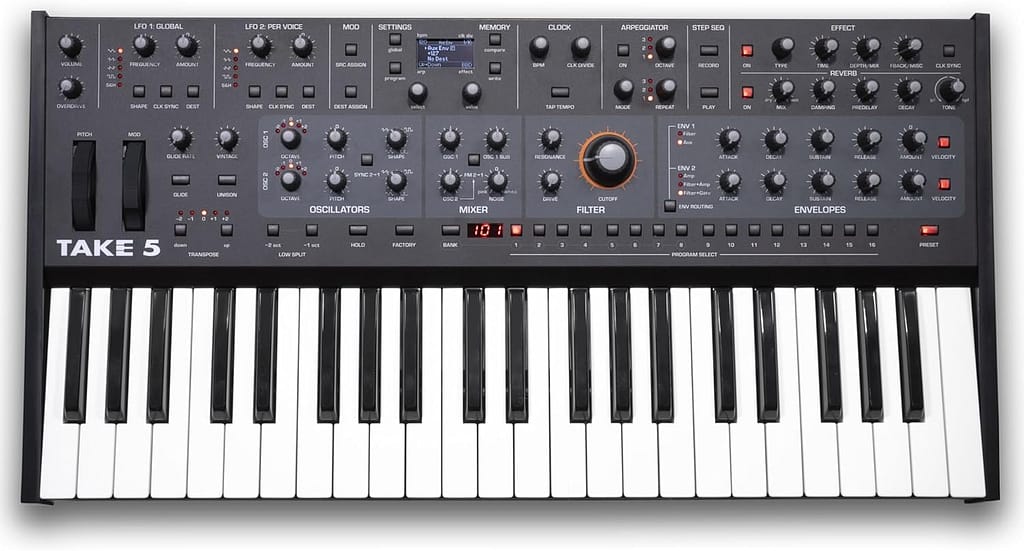
If you want one synth that covers a lot of techno territory without becoming a programming chore, the Sequential Take 5 is one of the strongest all-around options. Its analog voice structure gives you the punch and warmth needed for basses, chord stabs, and aggressive leads, while the modulation system is deep enough to keep repetitive patterns alive.
What makes it especially useful for techno is the balance. It is immediate enough to encourage fast sound design, but not so stripped down that every patch starts sounding similar. The built-in effects help with atmosphere, and the five-voice architecture is enough for most techno chords and layered sequences. The only real limitation is that if you need extensive multitimbrality or built-in drum sequencing, this is not that kind of workstation.
Best for raw analog drive: Moog Subsequent 37
For basslines, pressure, and tactile performance control, the Moog Subsequent 37 remains a serious contender. It has the kind of authoritative low-end and filter response that can anchor a track quickly. For darker techno, industrial sequences, and expressive mono parts, it is still one of the most satisfying hardware synths to play.
Its strength is also its limitation. This is not the widest sonic palette on the market, and it is not the most affordable route into techno hardware. But if your productions revolve around muscular mono lines and hands-on tweaking, it does exactly what it should.
Best digital option: ASM Hydrasynth
The Hydrasynth is one of the most capable digital synths for techno producers who want movement and complexity. Its modulation system is excellent, the wavetable engine is flexible, and the interface is far better than many similarly deep synths. It can do polished textures, unstable metallics, harsh digital percussion, and evolving pads with ease.
For techno, that means one box can cover drones, transitions, noisy tops, eerie chords, and aggressive sequences. It may not replace the visceral low-end behavior of a dedicated analog mono for every producer, but as a sound design instrument it is hard to ignore.
Best for sequencing-focused workflow: Korg Minilogue XD
The Minilogue XD earns its place because it is practical. It sounds good, it is approachable, and it gives techno producers enough analog body plus digital edge to stay interesting. The built-in sequencer and motion sequencing features are genuinely useful, not just spec-sheet filler.
This synth works especially well for producers who want one affordable hardware instrument that can sketch ideas quickly and still hold up in finished tracks. It does not have the deepest modulation system here, and its four voices can feel tight for more layered harmonic work, but for sequences, stabs, and compact studio setups it remains a strong value.
Best for modular-minded techno: Arturia MiniFreak
The MiniFreak is not a modular synth, but it appeals to the same curiosity. Its digital oscillator models, analog filters, and performance-oriented modulation make it unusually adaptable for techno. It can sound polished one moment and broken the next, which is useful in a genre built on tension and variation.
It is especially strong for producers who want unconventional hooks, strange percussion, and animated textures without committing to a full modular ecosystem. If your taste runs strictly toward classic analog tones, it may feel less direct than a more traditional subtractive instrument.
How to choose the best synthesizer for techno production for your setup
The best synth in a vacuum can be the wrong synth on your desk. If your tracks are mostly arranged in the DAW and you only need one hardware voice to add character, a strong mono or compact poly can be perfect. If you want the synth itself to drive ideas through sequencing and performance, workflow features become much more important than raw synthesis depth.
Budget changes the answer too. A less expensive synth with immediate controls will often contribute more to your music than a flagship model you barely understand. Techno rewards repetition and refinement, so an instrument you learn deeply has more value than one with endless options you never fully use.
Space and monitoring matter as well. Large, powerful analog synths can be inspiring, but if your room is untreated and your setup is compact, a controlled digital or hybrid instrument may translate better. Home-studio reality should shape the decision more than forum mythology.
Common mistakes when buying a techno synth
One mistake is buying for genre stereotype instead of personal method. Not every techno producer needs a classic analog monosynth, and not every modern producer needs a complex digital flagship. Start with what you actually program most often – bass, percussion, drones, chords, live sequences – and buy around that.
Another mistake is overvaluing presets or underestimating interface design. In techno, subtle parameter changes are a huge part of the sound. A synth that invites constant adjustment will usually serve you better than one with a bigger preset library and slower editing.
It is also easy to chase versatility when what you really need is character. A synth that does ten things adequately may lose to one that does three things brilliantly, especially if those three things are basslines, stabs, and modulation-heavy sequences.
The right choice is the one that makes you stay on a loop for twenty minutes because every small movement sounds promising. When a synth does that, it stops being a purchase decision and starts becoming part of your production language.